Commercial Insulation Guide: Types, Cost & Codes for West Texas Businesses
Everything a business, warehouse, or commercial-property owner in Seminole, Andrews, Lubbock, Midland, and Odessa needs to know before insulating — materials, energy code, tax incentives, cost drivers, and how to vet a contractor.
Key Takeaways
- The building envelope drives roughly a third of commercial energy use — insulation is an operating-cost decision, not a comfort afterthought.
- Closed-cell spray foam is the standard for metal buildings because it insulates and blocks the interior condensation ("building sweat") steel structures are prone to.
- Texas's currently adopted commercial code is the 2015 IECC — confirm exact R-value minimums for your building with a local official or contractor.
- The federal Section 179D tax deduction is time-limited — it no longer applies to construction beginning after June 30, 2026.
- Cost depends on six real variables (square footage, building volume, material, accessibility, retrofit vs. new, removal) — not a generic per-square-foot number.
If you own or manage a commercial building in West Texas — a warehouse, a metal shop, an office, or an ag-adjacent storage building — insulation is probably not the first thing on your mind. It should be closer to the top of the list than most owners realize. The U.S. Department of Energy frames it plainly: the building envelope accounts for roughly a third of commercial energy use, meaning the walls, roof, and insulation of your building are doing as much work on your utility bill as your HVAC system itself.
This guide walks through what commercial insulation actually is, the materials and methods used, how metal buildings and warehouses behave differently than a house, what the energy code actually requires (and what it doesn't), the tax incentives currently on the table, what installation looks like start to finish, what drives cost up or down, and how to vet a contractor before you sign anything. It's written for business owners, property managers, and facility operators across Seminole, Andrews, Lubbock, Midland, Odessa, and the surrounding West Texas counties — the same region Desert Spray Foaming has worked in since 2023.
What Is Commercial Insulation?
"Commercial insulation" covers insulation work done on non-residential buildings — the businesses, warehouses, shops, offices, and institutional buildings that operate under a completely different set of rules than a single-family home. It sounds like a small distinction, but it changes almost everything about how the job gets planned and executed.
The first difference is scale. A home might have a few thousand square feet of exterior wall and roof to insulate. A commercial building can run into the tens of thousands of square feet, and that scale changes the equipment, crew size, and staging required to do the work right. The second difference is the building envelope itself. Homes are almost always wood-framed. Commercial buildings in West Texas are far more likely to be pre-engineered metal buildings (PEBs), tilt-wall concrete, or steel-frame structures — assemblies that behave very differently thermally, especially around metal skin and thermal bridging through steel purlins and girts.
The third difference is the code path. Commercial buildings are regulated under the commercial provisions of the energy code, not the residential ones — a separate set of minimum requirements, compliance paths, and inspection triggers we'll get into in the next few sections. And the fourth is occupancy: how a commercial building gets insulated depends heavily on how the space is actually used. A fully occupied office needs comfort-level performance floor to ceiling. A bulk storage bay might only need targeted insulation at the roof to control condensation.
Pre-engineered metal buildings for ag storage, oilfield service shops, equipment barns, and light manufacturing; warehouses and distribution buildings ranging from fully conditioned to entirely unconditioned; office and retail buildings; and agricultural-adjacent commercial buildings — shops, equipment barns, and processing buildings tied to farm and ranch operations that are commercial in construction even if the owner thinks of them as "farm buildings." That last category is a significant, often-overlooked niche around Seminole and Gaines County.
One more distinction matters here: new construction insulation versus retrofit work. New construction lets insulation go in before the building is closed up and full of equipment or inventory — generally the more efficient path. Retrofit work happens on an existing structure, usually driven by comfort complaints, rising utility bills, or a change in how the space is being used, like converting unconditioned storage into occupied office space. For the full breakdown of how Desert Spray Foaming approaches commercial insulation projects of either type, that's the place to start.
Types of Commercial Insulation
There isn't one "right" insulation for commercial buildings — the right choice depends on the building type, the assembly, and what problem you're solving (comfort, moisture control, sound, energy code compliance, or some combination). Here's how the main options stack up.
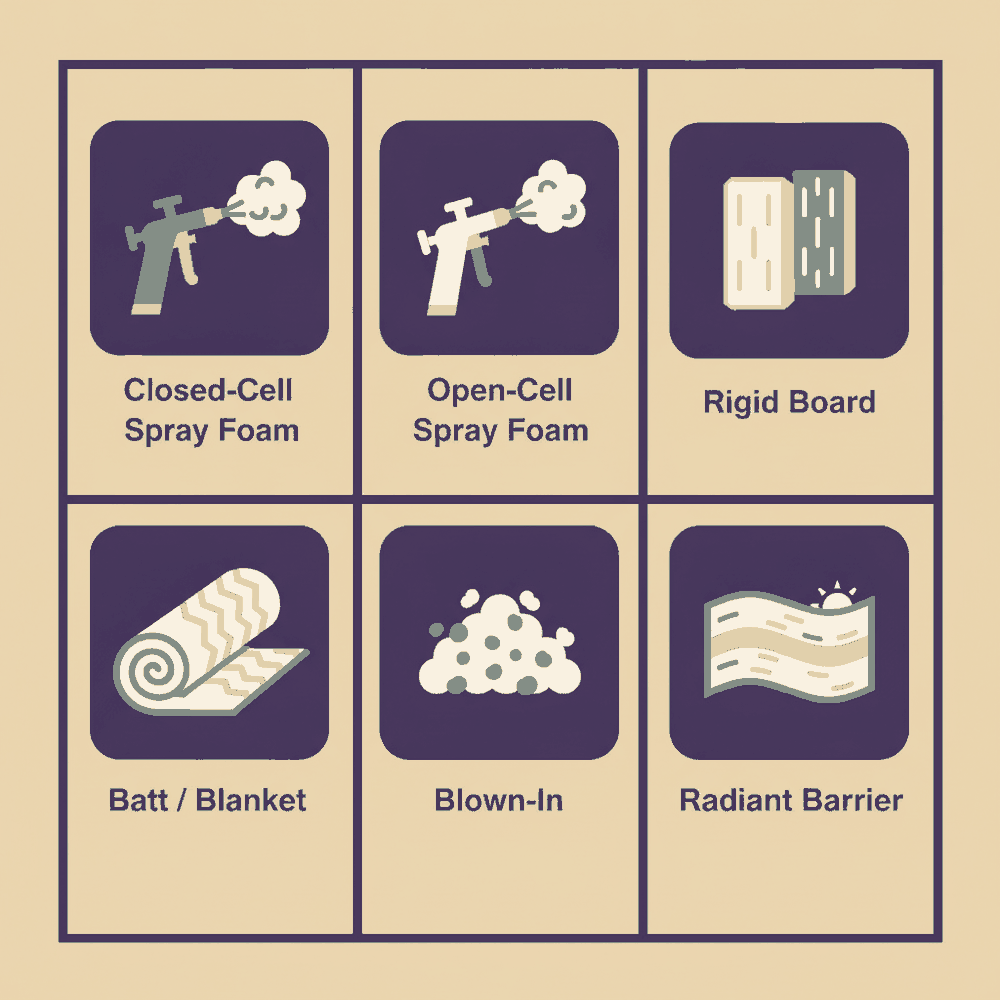
| Insulation Type | Typical R-Value | Best Commercial Fit | Key Notes |
|---|---|---|---|
| Closed-cell spray foam (ccSPF) | ~R-6 to R-7/in | Metal buildings, roof decks, cold storage, high-moisture applications | Doubles as an air barrier and, at sufficient thickness, a vapor retarder — critical in metal buildings prone to interior condensation. Adds structural rigidity. |
| Open-cell spray foam (ocSPF) | ~R-3.5 to R-3.8/in | Interior walls, sound-dampening, conditioned roof assemblies | Lower cost per inch; expands more, fills irregular retrofit cavities well; needs a separate vapor retarder in the wrong assembly. |
| Rigid board (polyiso, XPS, EPS) | R-4 to R-6.5/in | Roof insulation above deck, exterior continuous insulation | Common in commercial roofing systems and used to satisfy "continuous insulation" requirements a cavity fill alone often can't meet. |
| Batt/blanket (fiberglass, mineral wool) | R-3 to R-4.3/in | Metal building liner systems, interior partitions, office ceilings | Lower cost, but performance is very sensitive to installation quality — compression, gaps, and vapor drive are common failure points. |
| Blown-in (cellulose, fiberglass) | ~R-2.2 to R-3.8/in | Ceiling planes of conditioned office build-outs | Less common as a primary commercial envelope solution but useful in ceiling assemblies within larger buildings. |
| Radiant barrier | Not R-rated the same way | Metal building roofs in high-solar climates | Used alongside mass insulation, not instead of it — especially relevant in West Texas' high solar-load summers. |
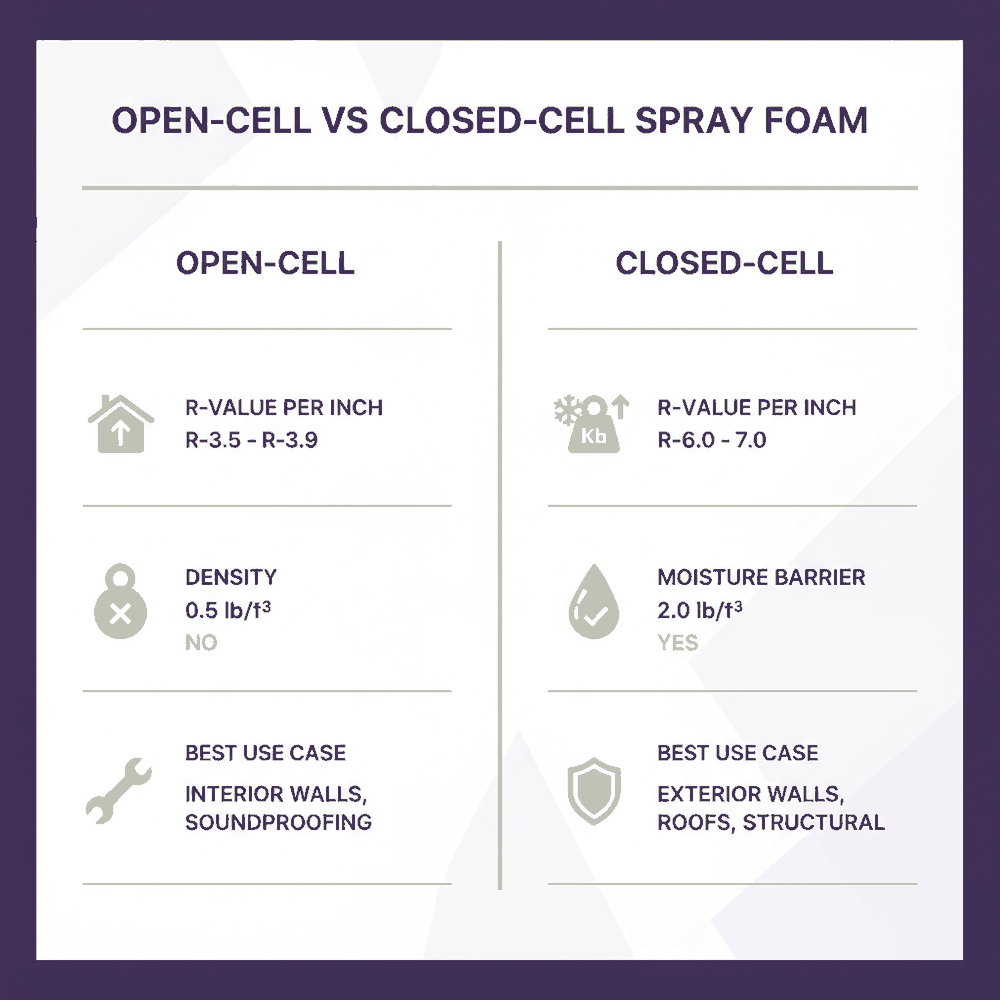
Open-cell vs. closed-cell spray foam
One question comes up more than almost any other. Closed-cell foam is denser, adds real structural rigidity, and blocks moisture completely — exactly why it's the standard choice for metal buildings and any assembly that needs a vapor barrier. Open-cell foam costs less per inch, expands more to fill irregular cavities (useful in retrofit work), and performs well for interior sound-dampening and air sealing where moisture control isn't the primary concern. Neither is universally "better" — the right choice depends on the assembly, the climate exposure, and whether vapor control is part of the job.
Metal buildings are prone to interior condensation — sometimes called "building sweat" — when warm, moist interior air contacts a cold metal skin. That mechanism barely exists in a wood-frame home, which is exactly why closed-cell spray foam, applied directly to the interior of the metal skin, has become the standard solution in cold storage, freezer buildings, and conditioned metal shops across this region.
Commercial Insulation for Metal Buildings & Warehouses
West Texas is metal building country. Oilfield service shops, ag equipment barns, light-industrial buildings, and warehouses across Seminole, Andrews, Lubbock, Midland, and Odessa are overwhelmingly pre-engineered metal structures — and metal buildings have a thermal problem that wood-frame homes simply don't: condensation.
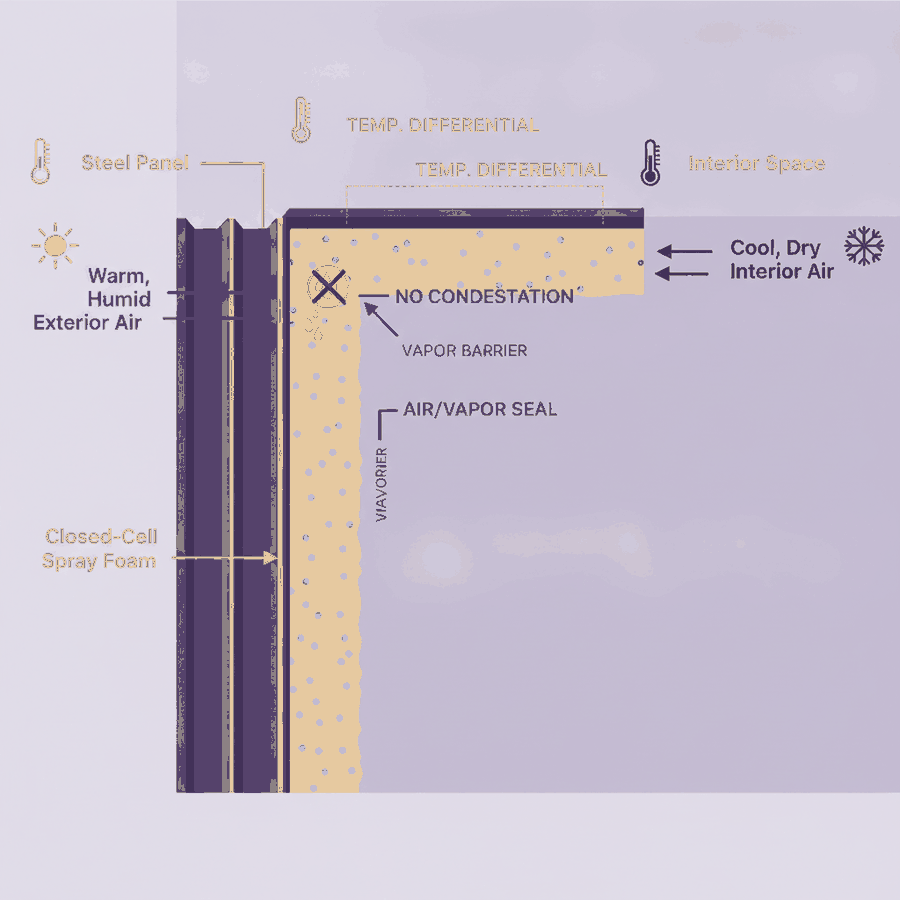
When warm, humid interior air meets a cold, uninsulated metal roof or wall panel, moisture condenses directly on the steel. Over time that leads to rust, dripping "rain" inside an otherwise dry building, damaged inventory, and a shortened life for the structure itself. It's a mechanical, physical reality of steel construction, not a defect — but it's entirely preventable. This is where closed-cell spray foam earns its reputation in the warehouse insulation and metal building insulation world: applied directly to the interior skin, it functions simultaneously as insulation, an air barrier, and a vapor barrier — addressing the condensation problem and the energy-loss problem at once.
A lot of the commercial buildings we work on in this region aren't purely one use case. It's common to find a hybrid layout: an occupied office or break room built into the corner of an otherwise unconditioned bay. In that scenario, the office envelope needs to be insulated to full comfort standards, while the surrounding bay space is treated differently — often still getting roof insulation for condensation and radiant-heat control, even if the bay itself isn't climate-controlled. Getting that scope right takes an assessment, not a guess, which is exactly why the process (Section 7) starts with a site visit rather than a quote over the phone.
Pole barns and ag-adjacent shop buildings fall into this same category. A pole barn used for equipment storage, a shop with a welding bay, or a processing building tied to a ranch operation is commercial in construction even if it doesn't look like a typical "business." These buildings benefit from the same condensation control and energy-efficiency logic as a warehouse — often at a smaller scale and a correspondingly smaller investment.
R-Value & Energy Code Requirements
Commercial buildings are regulated under a different rulebook than homes. The International Energy Conservation Code (IECC) publishes separate chapters for residential and commercial construction, and commercial buildings can generally demonstrate compliance either directly under the IECC's commercial provisions or by meeting ASHRAE Standard 90.1, the commercial energy standard referenced throughout the IECC framework.
In Texas specifically, the state's currently adopted commercial energy code is the 2015 IECC, in effect statewide for commercial, industrial, and multi-family (3+ story) construction since November 1, 2016, per the Texas State Energy Conservation Office (SECO). It's worth understanding why Texas runs a version behind the newest national code: SECO reviews and adopts new commercial code editions on a three-year cycle, following a public comment period and a cost-effectiveness analysis before any new edition is adopted statewide. A newer IECC edition may eventually replace the 2015 version — but as of this writing, the 2015 IECC is what governs commercial construction in Texas.
Commercial energy codes set minimum insulation values by building component (roof, wall, floor) and by climate zone, generally expressed as cavity insulation, continuous insulation, or a combination — a more layered approach than the single R-value many homeowners are used to from residential code. Because exact prescriptive tables shift with each code cycle, confirm the current requirement for your specific building component and climate zone with your local building official or a licensed contractor before finalizing a spec.
The West Texas High Plains and Permian Basin counties Desert Spray Foaming serves — Gaines, Andrews, Martin, Ector, Lubbock, Terry, and Yoakum — sit generally in IECC Climate Zone 3B (dry), reflecting the region's low humidity combined with a hot cooling season and genuine winter heating demand (Seminole holds the record for the coldest temperature ever recorded in Texas, -23°F, back in 1933). We describe it as Zone 3B rather than pinning an exact boundary to every property line, since the precise designation should be confirmed against the current county-level IECC zone map for your specific site.
Tax Incentives & Energy Savings ROI
Insulation upgrades pay for themselves twice — once through lower utility bills, and potentially again through a federal tax deduction that's currently on a countdown clock.
Properly insulated commercial buildings typically see 20-40% reductions in heating and cooling costs, with payback periods in the 3-7 year range depending on climate, building use, and how under-insulated the structure was to begin with. West Texas' wide seasonal swings — brutal summer heat load and genuinely cold winters — make that ROI case especially strong for an uninsulated or under-insulated metal building. ENERGY STAR's commercial buildings program cites energy savings of up to 30% for buildings that pursue benchmarking and efficiency upgrades, a figure that lines up closely with what we see on envelope-focused retrofits in the field.
On the tax side, the federal Section 179D Energy Efficient Commercial Buildings Deduction is the most direct financial incentive tied to insulation and envelope upgrades. The IRS's own guidance on the 179D deduction lays out the requirements: the property has to meet ASHRAE 90.1-referenced energy-efficient criteria and demonstrate a meaningful energy cost reduction to qualify. For approximate 2026 figures, the standard deduction rate runs roughly $0.59 to $1.19 per square foot, with an enhanced rate of up to approximately $2.97 to $5.94 per square foot for projects meeting prevailing wage and registered apprenticeship requirements. Under the 2025 One Big Beautiful Bill Act, 179D no longer applies to construction that begins after June 30, 2026. These figures and eligibility rules change, so confirm your specific project's qualification and current-year amounts with a tax professional. If you pursue the deduction, IRS Form 7205 is the form used to calculate and claim it.
One thing worth being direct about: there is no dedicated Texas state tax credit specifically for commercial insulation upgrades. What does exist, and varies by provider, are utility-run commercial energy-efficiency rebate programs. Because much of the Gaines, Terry, and Yoakum county trade area is served by rural electric cooperatives rather than a single statewide utility, program availability and amounts aren't standardized — check directly with your own electric provider for what's currently on offer.
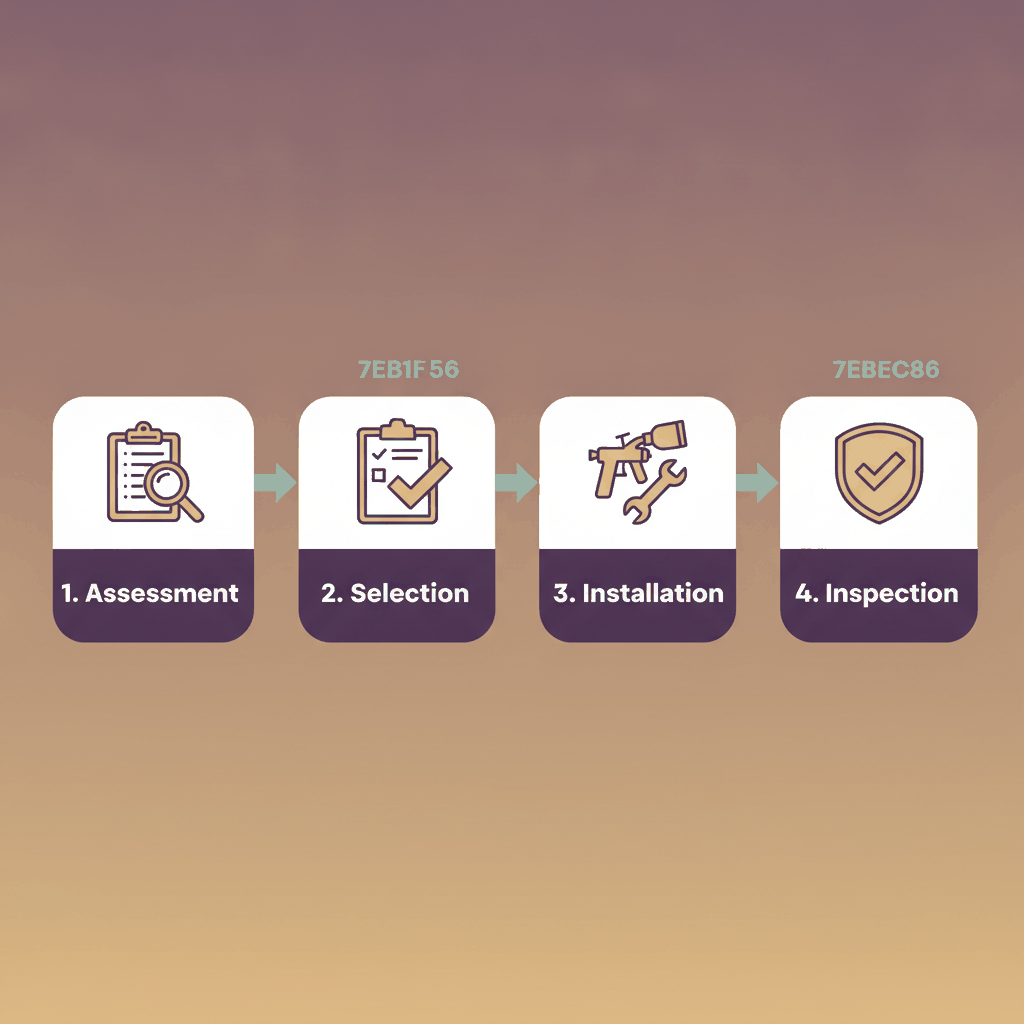
The Commercial Insulation Process
A commercial insulation job follows a more structured path than a same-day residential attic top-up, and understanding the sequence helps set realistic expectations for timeline and disruption.
1. Assessment & Audit
Site visit evaluating building type, conditioned vs. unconditioned zones, existing insulation condition, moisture history, and how the space is actually used.
2. Insulation Selection
Fully conditioned space gets closed-cell or a combined system; unconditioned storage may need only targeted roof insulation; hybrid buildings get a mixed scope.
3. Installation
Staging, protecting existing finishes and inventory, phasing by zone to avoid business disruption, larger crews and higher-output equipment.
4. Inspection & Completion
Code-required inspections where applicable, thickness/coverage verification, and a final walkthrough confirming scope completion.
Commercial-scale jobs require real staging — material delivery, proportioning equipment placement, and protecting existing finishes, equipment, and inventory in a building that's often still operating. Phasing by zone or bay is standard practice for commercial clients running a business out of part of the building while work proceeds elsewhere. Timeline is driven by square footage, ceiling height and building volume — not just floor area — and how many phases have to be coordinated around ongoing operations.
Commercial Insulation Cost Factors
We're not going to quote a fixed dollar-per-square-foot number here, and there's a good reason for that: commercial insulation cost is driven by variables that shift from building to building, and any generic figure you see online is likely wrong for your specific project by the time you get a real quote. Here's what actually moves the number:
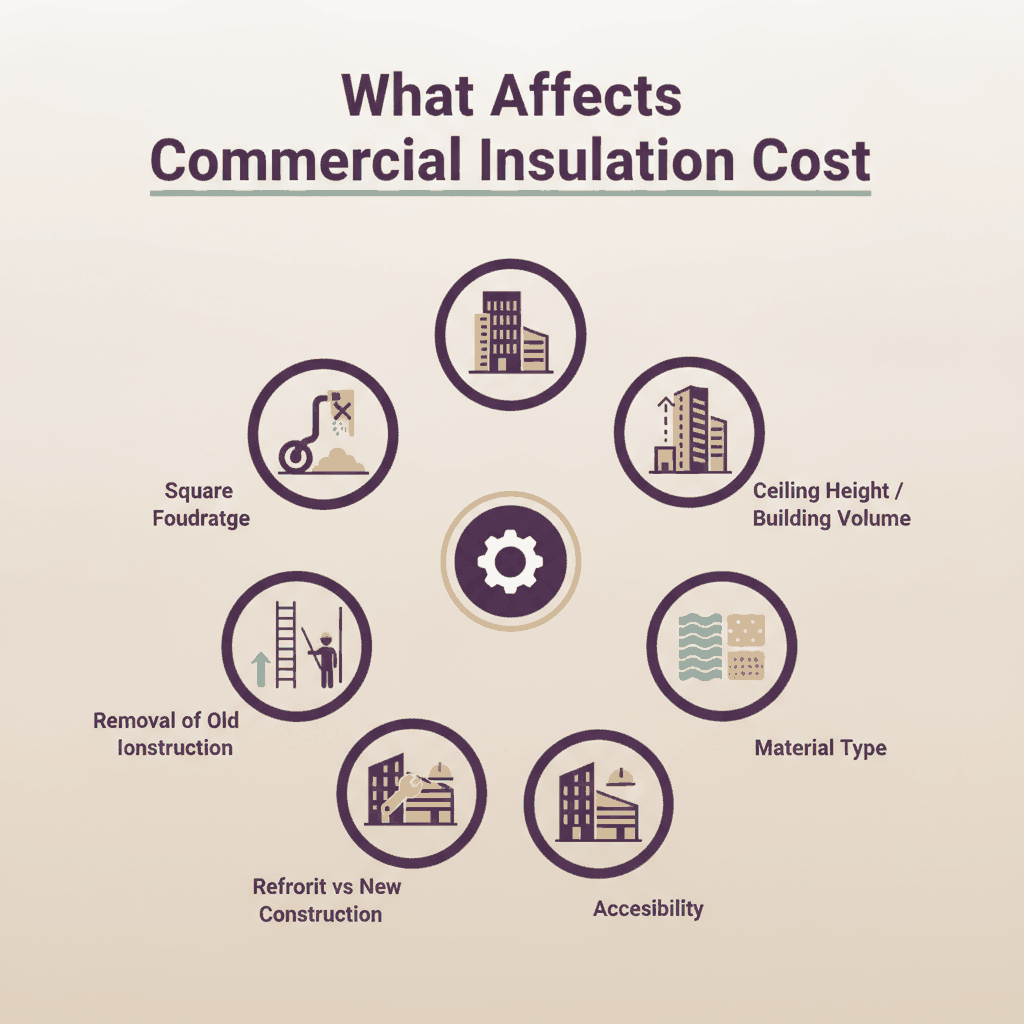
Square Footage
The baseline driver of material and labor cost — commercial jobs scale into far larger totals than residential.
Ceiling Height & Volume
Insulation goes on surface area, not floor area. A tall, clear-span warehouse has dramatically more surface per square foot of floor space.
Insulation Type
Closed-cell costs more per board-foot than open-cell or batt, but is often chosen for its air/vapor-barrier performance.
Accessibility
High roof decks, obstructed structural members, existing equipment, and active operations all add labor time.
Retrofit vs. New Construction
New construction allows insulation before the building is closed up; retrofit carries added logistics cost for phasing and protection.
Removal of Old Insulation
A failing, wet, or compromised prior system adds a removal/disposal step before new insulation goes in.
The honest answer to "how much will this cost" is: it depends on the six factors above, and the only way to get a real number is a site visit. Request a free quote and we'll walk your building, talk through your priorities, and give you an actual figure based on your square footage and building condition — not a generic estimate.
Choosing a Commercial Insulation Contractor
Not every insulation contractor is set up to handle a commercial-scale job, and the differences matter more than they might seem at first glance.
Certification
For spray polyurethane foam specifically, the credential to ask about is the Spray Polyurethane Foam Alliance's Professional Certification Program, an industry-recognized standard covering individual applicator training across multiple certification levels, along with a separate company accreditation track for contractors committed to SPFA's health, safety, and application-procedure standards. When vetting a commercial contractor, ask directly whether their crew holds current SPFA certification — it's a specific, verifiable credential, not a vague marketing claim.
Insurance sized for the job
Commercial projects carry meaningfully more liability exposure than a residential attic — larger structures, higher property values, an active business often operating on-site during the work. A commercial client should expect, and can reasonably ask to see, proof of general liability coverage sized appropriately for a commercial-scale project.
Commercial track record, not just residential
A contractor's home insulation portfolio doesn't automatically demonstrate they can staff, schedule, and execute a 30,000-square-foot metal building without disrupting an operating business. Ask specifically for commercial references and completed commercial projects — ideally in the same building stock common to this region.
Warranty terms & ability to work around live operations
Ask what's covered — material, workmanship, or both — for how long, and whether the warranty is contractor-backed, manufacturer-backed, or both. And given the phasing realities in Section 7, a contractor's demonstrated ability to execute in an occupied, operating facility is a real differentiator worth asking about directly.
Serving West Texas
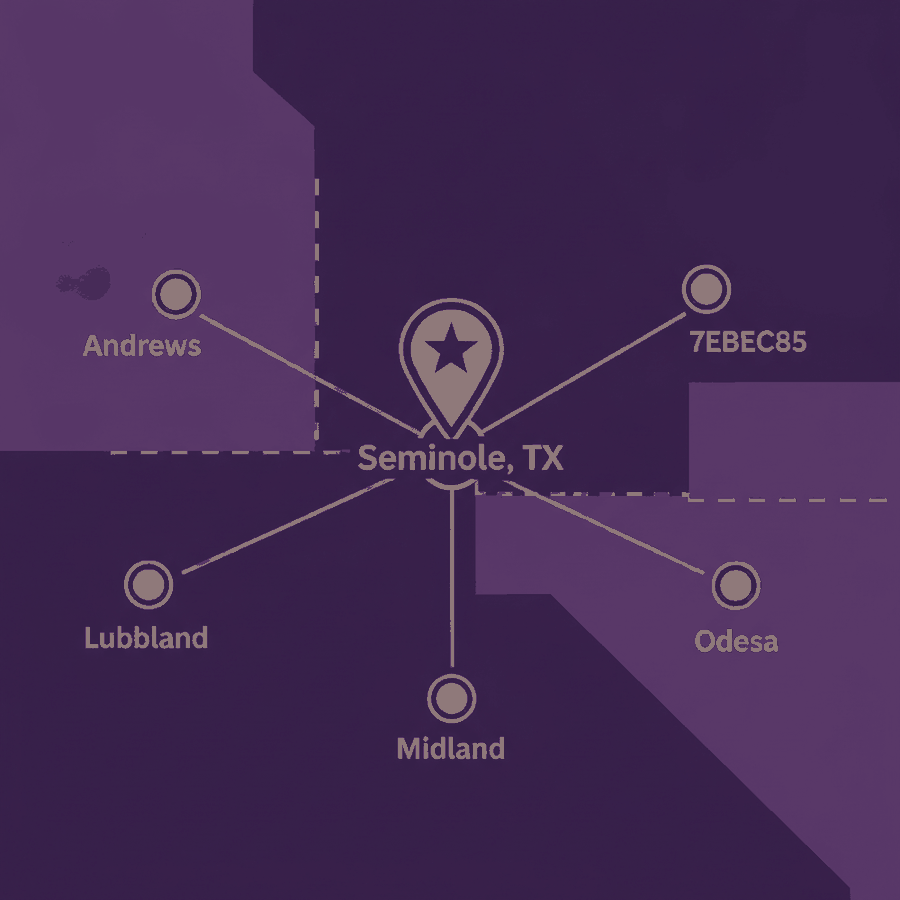
Desert Spray Foaming LLC is based in Seminole, Texas, at 150 FM 1429, and we serve commercial and industrial building owners across Andrews, Lubbock, Midland, Odessa, and the surrounding Andrews, Gaines, Lubbock, Terry, and Yoakum county trade area. This is the region we know — the metal buildings, the ag-adjacent shops, the oilfield service structures, and the climate swings that make insulation a genuine operating-cost issue rather than a nice-to-have.
Our team has been serving West Texas businesses since 2023, and owner Klass brings more than six years of hands-on experience in the insulation industry to every project — from a single-bay pole barn to a full metal warehouse. If you're a business owner in Odessa specifically, our dedicated commercial insulation in Odessa, TX page covers what we see most often in that market. Wherever you're located across the Permian Basin, if you're running a commercial or industrial building, we're close enough to walk the site and give you a straight answer.
Frequently Asked Questions
How much does commercial insulation cost?
Is spray foam insulation worth the cost for a warehouse or metal building?
What's the ROI on commercial building insulation?
Are there tax incentives for commercial insulation upgrades?
What type of insulation is best for a commercial metal building?
What's the difference between open-cell and closed-cell spray foam?
Does spray foam cause moisture or rust problems on metal buildings?
How long does a commercial spray foam job take?
Will insulation work disrupt my business operations?
What should I look for in a commercial insulation contractor?
How do I know if my commercial building's insulation needs replacing?
Get a Free Commercial Insulation Quote
Whether you're planning new construction, retrofitting an aging metal building, or trying to solve a condensation problem that's been draining your utility budget for years, the right insulation plan starts with an actual look at your building — not a guess over the phone. Desert Spray Foaming LLC has served commercial and industrial property owners across Seminole, Andrews, Lubbock, Midland, Odessa, and the surrounding West Texas counties since 2023, bringing owner Klass's 6+ years of hands-on insulation experience to every job.
Request Your Free Quote Call 432-209-9154