Open Cell vs Closed Cell Spray Foam: West Texas Guide
R-value, cost, and climate guidance for homes, shops, and metal buildings across Seminole, Andrews, Lubbock, Midland & Odessa — straight from the crews who spray it.
You're getting quotes for insulation and every contractor throws around “open-cell” and “closed-cell” like you already know what that means. Most don't explain the difference in plain language, and fewer still tell you which one actually fits your building.
This guide breaks down what changes between open-cell and closed-cell spray foam, from R-value and density to how they hold up in a wood-framed house versus a bare metal shop. You'll get a side-by-side comparison table, real cost numbers, and a straightforward decision framework so you're not guessing when a contractor gives you a quote.
West Texas isn't a generic climate, and that matters here. Seminole, Andrews, Lubbock, Midland, and Odessa all deal with a semi-arid climate: hot summers, cold winter nights, sharp day-to-night temperature swings, and near-constant wind. Most national spray foam blogs write for humid coastal states or mixed-humidity zones, and their advice quietly skips over the bare-metal pole barns, ag buildings, and shops that make up a huge share of the insulation work out here. That gap is exactly where this guide is aimed.
Desert Spray Foaming LLC is based in Seminole and works throughout Andrews, Gaines, Terry, and Yoakum counties as well as Lubbock, Midland, and Odessa. Everything below reflects what we actually see on job sites in this region, not a national average.
Key Takeaways
- Open-cell runs about R-3.5–3.8 per inch and costs less; closed-cell runs about R-6–7.0 per inch and costs 2–3x more per board foot.
- Closed-cell doubles as a vapor barrier and adds structural rigidity; open-cell does neither but dampens sound better.
- Metal buildings and pole barns need closed-cell regardless of climate — it stops dew-point condensation on cold steel.
- In West Texas's dry climate, wood-framed attics and interior walls can often use lower-cost open-cell if cavity depth allows it.
- There's no universal “better” foam — the right choice depends on substrate, cavity depth, moisture exposure, and budget.
What Is Open-Cell Spray Foam?
Open-cell spray foam is a two-part polyurethane. An installer sprays it as a liquid, made from an “A side” isocyanate and a “B side” resin blend, and the two react and expand in place. The name comes from the cell structure itself: as the foam expands, the tiny bubbles that form are intentionally left open, or ruptured, rather than fully sealed. That's what gives cured open-cell foam its soft, spongy, flexible feel compared to rigid closed-cell foam.
Density runs light, around 0.5 lb per cubic foot, and R-value lands around R-3.5 to R-3.8 per inch. That per-inch figure matters more than it sounds. See the Spray Polyurethane Foam Alliance's R-value and density comparison for the industry's own reference numbers on both foam types side by side.
Open-cell foam's biggest physical advantage is how much it expands: roughly 100 times its liquid volume. That aggressive expansion means it fills irregular stud bays, gaps around wiring and plumbing, and other obstructed cavities completely, creating a strong air seal even in framing that isn't perfectly clean. A real-world example of a modern open-cell product is Icynene's open-cell insulation product specifications, which show how manufacturers engineer for that same expansion and air-seal behavior.
Open-cell is vapor-permeable, meaning it is not a vapor barrier. Moisture vapor can pass through it, so assemblies using open-cell foam in humid climates typically still need a separate vapor-management strategy. It's also the better of the two foams for sound dampening. The porous, broken-cell structure absorbs airborne sound rather than reflecting it, which is why it shows up so often in media rooms, bedrooms next to noisy areas, and shared walls in multi-use commercial spaces. And because it uses less material per unit of coverage, open-cell foam generally costs less per board foot than closed-cell.

What Is Closed-Cell Spray Foam?
Closed-cell spray foam is also a two-part polyurethane, but it's formulated with a blowing agent that produces tightly packed, fully encapsulated cells instead of ruptured ones. That closed structure is what gives cured closed-cell foam its density, rigidity, and resistance to air and moisture movement.
Density comes in around 2.0 lb per cubic foot, roughly four times denser than open-cell, and R-value runs about R-6.0 to R-7.0 per inch, nearly double open-cell's per-inch performance. A modern closed-cell product like Heatlok HFO pushes that even further, reaching R-7.4 per inch in some formulations while spraying in a higher lift per pass and using a low-GWP blowing agent, which is a meaningful improvement over older closed-cell chemistries.
Because the cell structure is rigid and adheres strongly to framing or metal panels, closed-cell foam adds real structural value. It measurably increases the racking strength and rigidity of a wall or roof assembly, something open-cell simply doesn't contribute since it stays soft and flexible. Closed-cell also functions as a vapor control layer on its own. Applied at 1.5 to 2 inches, it drops below 1.0 perm, qualifying as a Class II vapor retarder under most building codes, and at 3 inches or more it can approach Class I, vapor-barrier-grade performance. That means a single application of closed-cell foam can serve as insulation, air barrier, and vapor retarder at once.
Closed-cell's cells don't readily absorb liquid water either, which is why it shows up in flood-prone areas, rim joists, and below-grade applications where moisture exposure is a real risk.
Open-Cell vs Closed-Cell: Side-by-Side Comparison

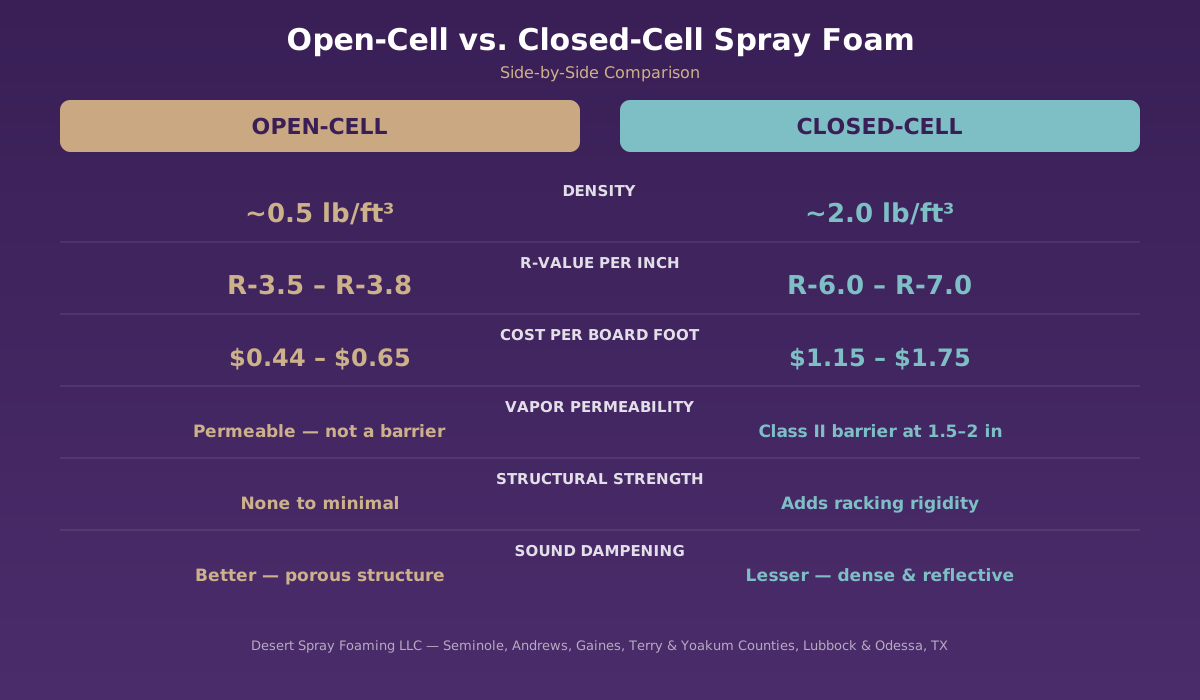
The numbers above tell most of the story, but seeing them side by side makes the tradeoffs clearer. Here's how the two foam types stack up across the factors that actually drive a buying decision:
| Attribute | Open-Cell | Closed-Cell |
|---|---|---|
| Density | ~0.5 lb/ft³ | ~2.0 lb/ft³ |
| R-value per inch | ~R-3.5–3.8 | ~R-6.0–7.0 (some HFO products higher) |
| Cost per board foot | ~$0.44–$0.65 (lower) | ~$1.15–$1.75 (2–3x open-cell) |
| Vapor permeability | Permeable, not a vapor barrier | Class II vapor retarder at 1.5–2″; near Class I at 3″+ |
| Structural strength | None to minimal, soft and flexible | Adds real racking strength and rigidity |
| Sound dampening | Better, porous structure absorbs sound | Lesser, denser and more reflective |
| Expansion ratio | ~100x liquid volume | ~30–60x liquid volume |
| Moisture/mold resistance | Absorbs some vapor, needs added vapor control in humid assemblies | Resists bulk water and vapor intrusion, suited to flood zones and exterior-adjacent uses |
| Max thickness per pass (“lift”) | Not exothermic-limited the same way, can go in a single thicker pass | ~1–2 in per pass standard (up to ~2.5–4 in for high-lift formulations), needs cooldown between passes |
The compressive-strength classes spray foam has to meet for structural and code purposes are formalized under the ASTM C1029 standard for spray polyurethane foam, which is worth knowing if a contractor's quote references a specific foam grade.
Three differences drive most West Texas buying decisions: R-value per inch, whether it doubles as a vapor barrier, and whether it adds structural rigidity. Everything else — sound, cost, expansion — matters too, but these three usually decide the call.
West Texas Climate Guidance: Wood-Framed Homes vs. Metal Buildings & Pole Barns
Wood-Framed Homes & Attics in a Dry, Wide-Swing Climate
In a truly semi-arid climate, moisture control is a lower priority than it is in humid or coastal regions, which changes the calculus for our spray foam insulation services in wood-framed homes and attics. The decision between open-cell and closed-cell in a Seminole or Lubbock attic usually comes down to budget, available cavity depth, and whether sound control matters, not moisture risk.
Applied at sufficient thickness with enough cavity depth to reach, open-cell foam in attics and interior walls performs comparably to closed-cell in dry climates like ours, and it typically costs less to install. Where closed-cell still wins on a wood-framed job is cavity depth. In a 2x4 wall or a shallow rafter bay, closed-cell's higher R-value per inch lets you hit code-minimum or target R-value in a fraction of the space open-cell would need.
There's also a wind angle that's easy to overlook. Wind-driven infiltration through gaps at penetrations, band joists, and top plates is a real driver of both energy loss and drafty comfort complaints in West Texas homes, and spray foam's continuous, gap-free seal resists that infiltration far better than batt insulation regardless of which type you choose. For unvented attic assemblies specifically, DOE and PNNL document the tradeoffs well: DOE/PNNL's guide on unvented attic assemblies insulated with spray foam covers exactly this open-cell-versus-closed-cell decision by climate zone, and Building Science Corporation's residential spray foam guide reinforces that low-density open-cell needs an added vapor retarder in colder climate zones but is generally workable on its own in a true dry climate zone. Attic insulation is one of the highest-leverage upgrades a West Texas homeowner can make, whichever foam ends up being the right fit.
Metal Buildings, Pole Barns & Shops: Closed-Cell Is the Climate-Independent Standard
Metal buildings and pole barns are the one category where closed-cell wins regardless of climate, and the reason is worth understanding rather than just taking on faith. It's not about humidity in the ambient-air sense. It's about condensation.

Clear desert nights cause rapid radiative cooling of bare steel roofing and wall panels. Even in a dry region, interior humidity from occupants, equipment, or livestock can condense on that cold steel once its surface temperature drops below the interior dew point. This is dew-point condensation driven by temperature swing, not ambient humidity, and it's exactly the kind of “sweating” metal building owners see on the underside of their roof panels on cold mornings. Closed-cell foam bonded directly to the metal stops this before it starts, because the foam layer keeps the interior-facing surface above dew point.
Closed-cell also creates a continuous air and vapor barrier at the panel seams, which resists wind-driven rain and dust infiltration, a real factor given West Texas's wind load. And because closed-cell adds meaningful rigidity to thin steel panels, it functions as real reinforcement for pole barns, ag buildings, and shops under wind stress, not just insulation.
A typical spec is around 2 inches of closed-cell on the interior face for R-12 to R-14 with vapor-barrier performance in milder zones, with deeper applications from 3 to 6-plus inches for colder needs.
Cost & ROI: What to Expect to Invest
Cost figures for spray foam get reported two different ways, and it can look contradictory if you don't know which one you're reading. Material-only pricing runs roughly $0.44 to $0.65 per board foot for open-cell and $1.15 to $1.75 per board foot for closed-cell. Fully-installed retail pricing, which includes labor, equipment, and overhead, runs higher: roughly $1 to $1.50 per board foot for open-cell and $1.50 to $3-plus per board foot for closed-cell. Both figures are accurate; they're just measuring different things. When you get a quote, ask whether the number you're seeing is material-only or fully installed so you're comparing apples to apples.
On the energy side, industry sources commonly cite a 15 to 50 percent reduction in energy bills after switching to spray foam from conventional insulation, with payback periods typically landing in the 3 to 7 year range, and many residential jobs narrowing to 3 to 5 years. ENERGY STAR's own guidance confirms that air sealing combined with insulation can lower energy bills by double digits, and spray foam is one of the few insulation types that air-seals and insulates in the same step.
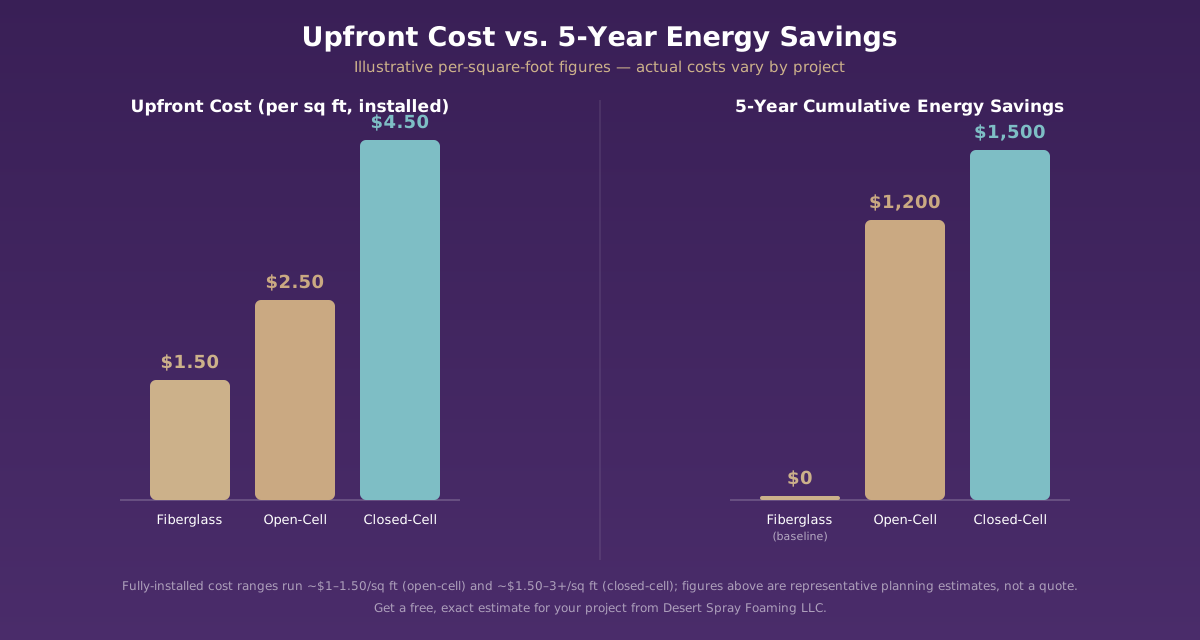
Durability matters here too. Spray foam doesn't settle, sag, or lose R-value over time the way fiberglass batts or blown cellulose can. For West Texas ag and commercial building owners planning to own a property for decades, that turns the upfront premium into a long-term asset rather than a short-term expense you have to justify against a 3 to 5 year window. There's also a secondary benefit worth factoring in: buildings with spray foam's lower infiltration loads often let HVAC systems run less aggressively, or get downsized on new construction, which is its own cost savings beyond the utility bill.
Which Foam Should You Choose? Use-Case Decision Guidance

One more option worth a brief mention: some jobs use a “flash and batt” approach, a thin layer of closed-cell foam against the roof deck or sheathing for air and vapor sealing, topped with cheaper batt insulation to fill the remaining depth. It's a legitimate cost-optimization technique for the right project, though full-fill foam, either type, remains the more common and simpler approach for most whole-cavity jobs.
Common Misconceptions About Spray Foam Insulation
Frequently Asked Questions
What's the difference between open-cell and closed-cell spray foam?
Open-cell foam has ruptured cell walls, is soft and spongy, and runs about R-3.5 to R-3.8 per inch. Closed-cell foam has intact, tightly packed cells, is rigid, and runs about R-6 to R-7 per inch. Closed-cell also blocks moisture and adds structural rigidity, while open-cell costs less and dampens sound better.
Which is better, open-cell or closed-cell spray foam?
Neither is universally better. It depends on the application. Closed-cell wins for moisture control, structural strength, and roof decks or metal buildings. Open-cell wins on cost and sound dampening for interior walls. A qualified installer picks the right foam for each area of your building rather than defaulting to one answer.
How much does open-cell vs. closed-cell spray foam cost?
Material-only pricing runs about $0.44 to $0.65 per board foot for open-cell versus $1.15 to $1.75 for closed-cell, while fully-installed pricing runs roughly $1 to $1.50 and $1.50 to $3-plus respectively. Closed-cell needs less thickness to hit a target R-value, which partly offsets the higher price on shallow cavities. Contact us for a free estimate to get exact numbers for your project.
Can I install spray foam insulation myself with a DIY kit?
DIY kits can work for small, simple jobs under roughly 500 square feet, but they commonly use 20 to 30 percent more material from application errors, carry no warranty, and off-ratio spraying can mean paying later to remove and redo the work. For attics, whole walls, or metal buildings, professional application is the safer and usually cheaper long-run choice.
Is spray foam off-gassing dangerous, and how long do I need to stay out?
There's a temporary off-gassing period during cure. Open-cell generally clears within about 24 hours, while closed-cell, being denser, is commonly recommended at 24 to 48 hours before re-entry. Once fully cured, both types are considered safe and inert; the only real exposure risk is during that initial curing window.
Which spray foam is best for a pole barn or metal building?
Closed-cell is the standard choice for pole barns and metal buildings because it resists moisture, adds rigidity to thin steel panels, and stops condensation on the underside of metal roofing, a common problem in shops and ag buildings that see big temperature swings.
Which foam is better for attics, open-cell or closed-cell?
Closed-cell is often favored for unvented, conditioned attics and roof decks because it acts as its own vapor barrier and doesn't depend on attic ventilation. Open-cell is a lower-cost option when the attic keeps proper ventilation and cavity depth is sufficient, but your specific roof design and climate should drive the final call.
Does spray foam insulation prevent mold and moisture problems?
Closed-cell foam resists moisture absorption and blocks vapor intrusion, which helps prevent the conditions mold needs to grow. Open-cell is breathable and can absorb some moisture in humid conditions, so it may need an added vapor barrier, less of a concern in West Texas's dry climate but still worth checking near plumbing walls or evaporative cooling systems.
What's the R-value difference between open-cell and closed-cell, and does it matter?
Closed-cell delivers roughly double the R-value per inch of open-cell, about R-6 to R-7 versus R-3.5 to R-3.8. That difference matters most where cavity depth is limited, like shallow rafter bays or 2x4 walls, since closed-cell reaches your target R-value in far less physical space. Where depth isn't a constraint, open-cell can reach the same total R-value at a lower material cost.
Conclusion
There's no universal “better” foam between open-cell and closed-cell. The right choice depends on where in the building you're insulating, what substrate you're spraying onto, how much cavity depth you have, your budget, and how much moisture or structural performance the assembly needs.
For West Texas specifically, the takeaway is straightforward. Closed-cell is the default for metal buildings and pole barns regardless of climate, because it stops condensation on cold steel and adds real structural rigidity under wind load. Open-cell is a smart, cost-effective choice for wood-framed interior walls and attics with adequate cavity depth, where our dry climate makes moisture control a lower priority than budget and sound performance.
Rather than guessing which foam your project needs, get a free, honest assessment from Desert Spray Foaming LLC. We serve Seminole, Andrews, Gaines, Terry, and Yoakum counties, as well as serving Lubbock and Odessa.
Not Sure Which Foam Your Building Needs?
Get a straight answer, not a sales pitch. Desert Spray Foaming walks your building, tells you what's actually required, and gives you an honest quote.