Preparing for Texas Summers: The Insulation Checklist Every Homeowner Needs
West Texas doesn't ease into summer — it arrives. Here's how insulation, attic ventilation, and air sealing work together to get a Seminole, Andrews, Lubbock, Midland, or Odessa property ready before the first 100°F stretch hits.
West Texas doesn't ease into summer — it arrives. By late May, Seminole, Andrews, Lubbock, Midland, and Odessa are already stacking up 95°F-plus afternoons, and by July the region settles into a stretch of triple digits that doesn't let up until September. For homes and outbuildings across Andrews, Gaines, Lubbock, Terry, and Yoakum counties, that heat doesn't just make the outdoors uncomfortable — it pushes directly on your roof, your attic, and ultimately your air conditioner, all day, every day, for months.
The good news: the same way West Texans winterize a home in the fall, a home can be summer-prepped in the spring. And the single biggest lever for how well a building handles that heat is insulation — backed up by two systems that work alongside it: attic ventilation and air sealing. Get all three right before the first 100°F stretch, and the difference shows up in comfort, in the sound of the AC cycling less often, and on the electric bill.
This guide walks through why West Texas summers are uniquely hard on a building's thermal envelope, how insulation actually stops heat (not just cold), what role ventilation and air sealing play, and a complete pre-summer inspection checklist you can run through on your own home, pole barn, or commercial building before the heat sets in.
Key Takeaways
- West Texas attics can hit 130–150°F on a 90°F day if under-insulated and poorly ventilated — a healthy, well-prepped attic should run only 10–20°F above outdoor temperature.
- DOE and ENERGY STAR recommend R-38 to R-49 attic insulation for this climate zone; R-38 alone blocks roughly 97% of ceiling heat transfer.
- Insulation, air sealing, and ventilation are three separate systems that all have to work together — none of them substitutes for the other two.
- A full air seal can cut HVAC load by 20–40% on its own, on top of whatever insulation is already doing.
- The best time to inspect and upgrade is April–May, before the first sustained 100°F stretch — not after the electric bill spikes in July.
Why West Texas Summers Push Homes to Their Limit
Seminole, Andrews, Lubbock, Midland, and Odessa sit in a climate zone that combines intense, nearly cloudless solar radiation with long stretches of sustained heat. National Weather Service climate records for the Midland-Odessa area show July average highs in the mid-90s, and once a heat ridge sets up over West Texas in July and August it isn't unusual to sit at or above 100°F for a week or more at a stretch.

That combination — high solar intensity, low humidity that lets roof and attic surfaces heat quickly, and long duration — is harder on a building's envelope than a shorter, more humid heat season elsewhere. A roof that bakes at full sun intensity for 12+ hours a day is transferring an enormous amount of heat downward into the attic, and from the attic into the living space below, all day long.
That's the frame for everything in this guide: in this region, the building envelope (insulation + air sealing + ventilation working together) isn't a nice-to-have. It's the difference between an AC system that keeps up and one that runs constantly and still loses ground on the hottest afternoons.
Understanding Your Climate Zone
Building codes classify West Texas — the counties Desert Spray Foaming serves, including Gaines, Andrews, Lubbock, Terry, and Yoakum — primarily under IECC Climate Zone 3B, a "warm-dry" designation. That "dry" half of the classification matters as much as the "warm" half: low humidity means less cloud cover to block solar radiation, so roofs absorb more direct heat per daylight hour than they would in a humid climate zone at the same latitude. It also means radiant heat gain, not just ambient air temperature, drives a large share of the summer cooling load here — which is exactly the kind of heat transfer insulation and a well-sealed envelope are built to resist. Homes just north toward the Panhandle sit in Zone 4A and see slightly cooler averages but similar solar intensity, while areas further south toward Midland and Odessa run marginally hotter through peak summer. Across the whole service area, the practical target stays consistent: R-38 to R-49 attic insulation, a balanced ventilation system, and a tight air seal.
How Attic Heat Actually Gets Into Your Living Space
Most homeowners think of insulation as a winter thing — something that "keeps the heat in." In summer, the exact same material is doing the opposite job: holding outdoor heat back from getting in. Insulation resists heat flow in both directions; R-value doesn't care which way the heat is trying to move.
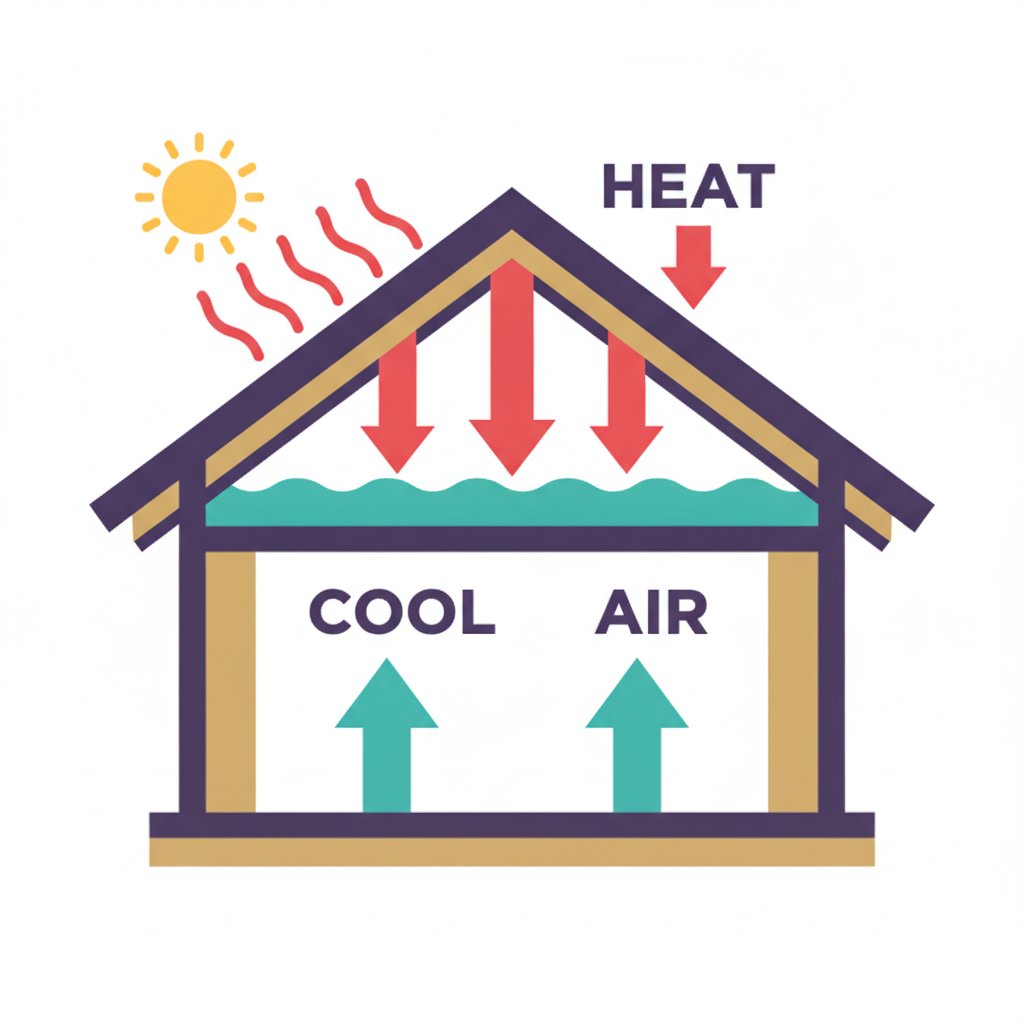
Here's what happens without enough of it. On a typical West Texas summer afternoon, an attic with thin, settled, or gapped insulation and weak ventilation can reach 130–150°F, even when it's "only" 90–95°F outside. A properly insulated, properly ventilated attic, by contrast, should run just 10–20°F above outdoor ambient. That 40–60-degree difference sits directly above your ceiling, radiating and conducting heat down into every room below — all day and well into the evening, since attic framing and roof decking hold heat and release it slowly after sundown.
This is also where insulation settling becomes a silent problem. Fiberglass batt and blown-in insulation can compress and settle over years — sometimes 20-30% below its original depth — without any visible sign from inside the house. A home that had adequate insulation when it was built can be well under today's recommended levels a decade or two later, and the only way to know is to actually look.
Insulation — Your Home's First Line of Defense
The Department of Energy and ENERGY STAR's recommended R-value chart put this region's attic insulation target at R-38 to R-49, depending on exact climate zone — Seminole and the surrounding counties generally fall in the R-38-to-R-49 range, with the higher end appropriate for homes that run cooling hard through the summer. At full, uncompressed depth, R-38 alone blocks roughly 97% of the heat transfer that would otherwise move through an uninsulated ceiling. Texas adopts the International Energy Conservation Code (IECC) as its statewide baseline, and the Department of Energy's insulation and air-sealing guidance confirms the same R-38-to-R-49 range for this region's code-minimum floor — but "code minimum" and "ideal for a West Texas summer" aren't always the same number, and existing homes are often below even the code minimum once settling is factored in.
Spray foam insulation is a strong fit for this climate specifically because it does two jobs that batt and loose-fill insulation don't do as well together: it delivers a high R-value per inch, and it forms a continuous air barrier at the same time, closing the small gaps around framing, wiring, and penetrations that batt insulation simply drapes over.
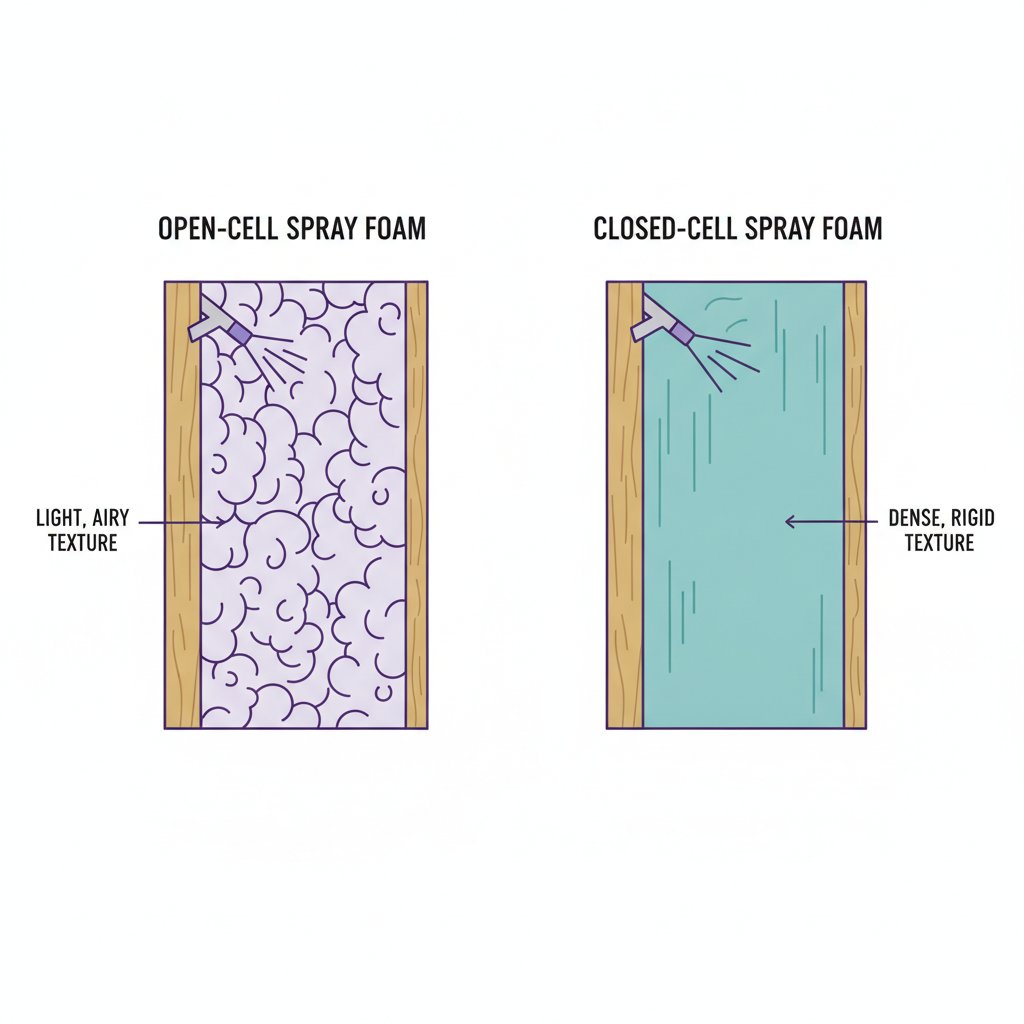
| Foam Type | R-Value per Inch | Best For |
|---|---|---|
| Open-cell spray foam | R-3.4 – R-3.5 | Interior wall cavities, budget-conscious attic-floor applications, thorough expansion coverage in irregular spaces |
| Closed-cell spray foam | R-5.6 – R-6.5 (up to ~R-10 at 1" when freshly installed) | Metal buildings, pole barns, roof-deck applications — adds structural rigidity plus a moisture barrier |
Open-cell spray foam runs roughly R-3.4 to R-3.5 per inch. It's lighter, more affordable per board-foot, and expands to fill irregular cavities thoroughly — a strong choice for interior wall cavities and many attic-floor applications where budget and expansion coverage matter most.
Closed-cell spray foam runs R-5.6 to R-6.5 per inch (with fresh closed-cell foam testing closer to R-10 at one inch when newly installed), and it adds structural rigidity plus a built-in moisture barrier. That combination makes it the stronger option for metal buildings, pole barns, and roof-deck applications where both thermal performance and structural stiffening matter, and where West Texas's occasional wind-driven rain makes the moisture barrier a genuine bonus rather than an afterthought.
Either way, the payoff is real: properly sized insulation, installed at full depth, can reduce attic temperatures by up to 30°F compared to an under-insulated attic — which translates directly into less AC cycling, more even room-to-room temperatures, and a lighter load on equipment that's already working overtime through a West Texas July. Our spray foam insulation and attic insulation services are built around exactly this: matching foam type and R-value to what a specific West Texas building actually needs, not a one-size-fits-all spec.
New Construction vs. Existing Homes
The approach differs depending on whether a building is going up now or has been standing for years. New construction insulation gets the advantage of being installed before drywall closes the walls and ceiling, which means full, uncompressed coverage from day one and the chance to plan air-sealing detail work — around top plates, penetrations, and the attic hatch — into the build sequence rather than retrofitting it later. Existing homes are a different job: the first question isn't "what foam type" but "what's actually in there right now, and how much has it settled." That's why a pre-summer inspection matters more for a 10- or 20-year-old home than for new construction — settled batt or blown-in insulation can be quietly running 20-30% under its original depth with zero visible symptoms other than a creeping electric bill. For homes where existing insulation has degraded, gotten wet, or is simply the wrong type for the space, insulation removal ahead of a fresh install is sometimes the more cost-effective path than layering new material over compromised old material.
It Takes More Than Insulation: Ventilation Matters Too
Insulation resists heat flow through the attic floor. It does nothing, by itself, about how hot the attic cavity above that insulation gets — that's the job of ventilation. ENERGY STAR's attic ventilation guidance describes the goal simply: get fresh air in low, and let hot, moist air out high, continuously, without depending on mechanical power.
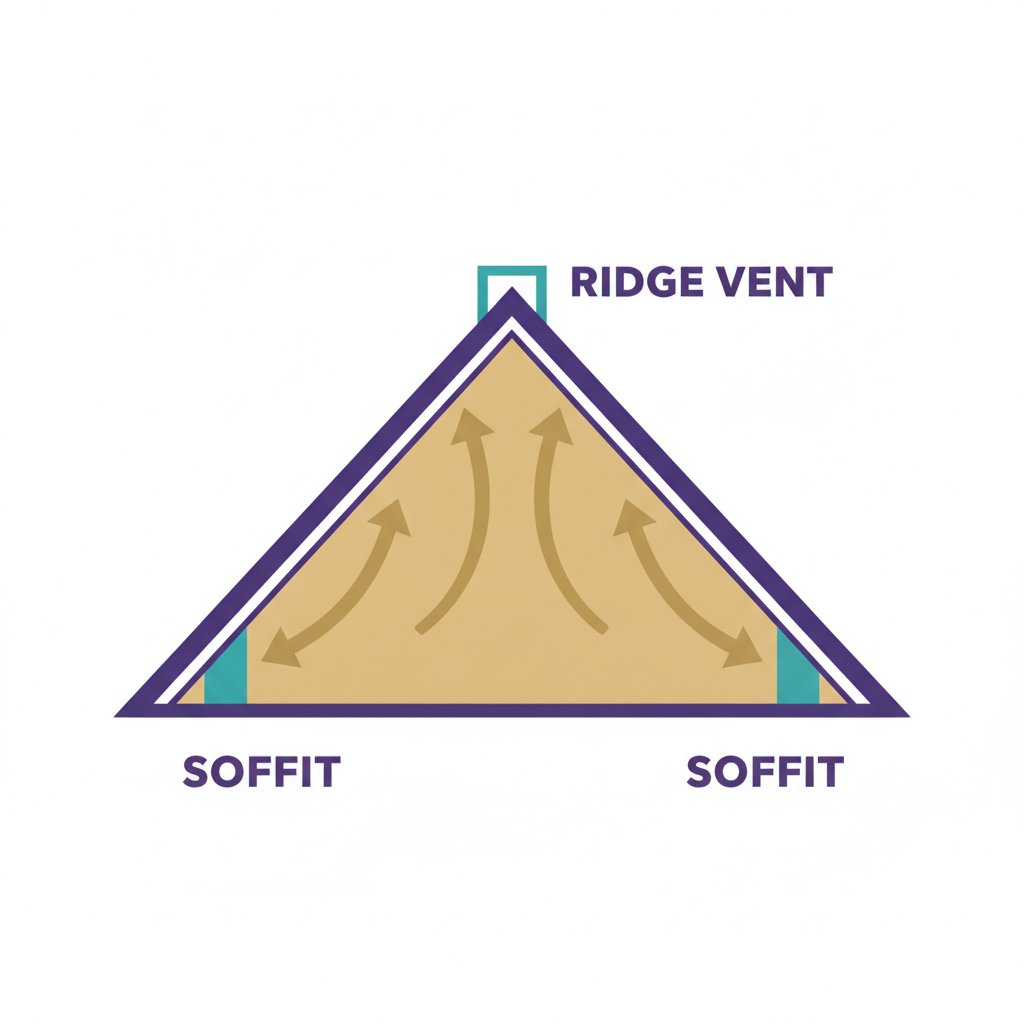
One clarification worth making explicitly: vented attics with spray foam on the attic floor still need normal soffit-and-ridge ventilation, exactly like any other attic. The exception is an unvented "hot roof" assembly, where spray foam is applied directly to the underside of the roof deck instead of the attic floor, creating a conditioned attic by design. That's a different, deliberate construction choice — not a sign that ventilation was skipped.
Air Sealing — Closing the Gaps Insulation Can't
Even a thick layer of insulation can't stop hot, humid outside air from moving straight through gaps around recessed lighting, plumbing and wiring penetrations, top plates, and attic hatches. Air sealing closes those specific pathways — with spray foam, caulk, or weatherstripping depending on the gap — so that outside air has to go through the insulation's resistance rather than around it entirely.
The payoff is significant on its own: a complete, well-executed air seal can cut HVAC load by 20–40%, on top of whatever the insulation itself is contributing (the U.S. Department of Energy's Building America research). It's also one of the most cost-effective single upgrades available, because it's targeting specific, identifiable leaks rather than replacing an entire system.
Your Pre-Summer Inspection Checklist
This is the checklist we recommend running every spring, ideally in April or May before the year's first sustained 100°F stretch — the same logic as scheduling a furnace check before the first cold snap, just flipped for the season. It follows the same order the Building America Solution Center's checklist recommends: inspect and address safety and moisture issues first, confirm ventilation is working, and only then evaluate and top up insulation.

- Check attic access safety first. Confirm there's no active knob-and-tube wiring, vermiculite insulation, or unvented gas/kerosene appliances venting into the attic before doing any hands-on inspection.
- Look for roof leaks or moisture staining on the underside of the decking and around any penetrations — moisture problems need to be fixed before insulation work, not covered up by it.
- Confirm soffit vents are clear. Insulation, debris, bird nests, or paint can block soffit vents from the outside or inside — clear any obstruction so intake air can actually flow.
- Confirm ridge or other exhaust vents are unobstructed and check that the intake-to-exhaust ratio is roughly balanced, not dominated by one or the other.
- Check insulation depth and condition. Look for thin spots, compression, gaps around framing, and joists that are visible through the insulation — any of these mean coverage has dropped below target.
- Inspect for air-sealing gaps around recessed lighting, plumbing stacks, wiring penetrations, the attic hatch or pull-down stair, and top plates where interior walls meet the attic floor.
- Check exposed HVAC ductwork in the attic for visible holes, disconnected joints, crushed sections, or duct insulation that's degraded — a duct leak in a 140°F attic is losing cooled air directly into the worst possible place.
- Check pole barns, metal buildings, and outbuildings on the property with the same eye toward insulation condition and any obvious heat-gain problem areas — metal structures heat even faster than a shingled roof.
- Schedule any insulation top-up, air sealing, or ventilation correction before the heat arrives — April and May give enough lead time to get it done before the first heat dome sets in, rather than trying to schedule work mid-July when every insulation crew in West Texas is booked solid.
Running this checklist doesn't require tearing into the attic yourself for every item — the visual inspection steps (1-3, 5-6, 8) can usually be done from the attic hatch with a flashlight, while ductwork and full insulation-depth assessment (4, 7) are worth having a contractor confirm, especially if it's been several years since the attic was last checked.
Commercial, Pole Barns & Metal Buildings Need This Too
West Texas's building stock isn't just single-family homes — this region runs on pole barns, metal buildings, warehouses, and commercial structures across Andrews, Gaines, Lubbock, Terry, and Yoakum counties, and metal conducts and radiates heat considerably faster than a shingled residential roof.

For metal buildings specifically, closed-cell spray foam's combination of high R-value per inch, structural rigidity, and built-in moisture barrier is usually the right call — it adheres directly to the metal panel, eliminates the condensation problems metal buildings are prone to without insulation, and holds up under the same summer heat load that a house attic experiences, just distributed across a much larger uninterrupted roof surface. Our home insulation work covers the residential side of this, while commercial, new-construction, pole barn, and metal building insulation are handled with the same underlying approach: match the foam type and thickness to the structure and the heat load it's actually carrying.
Warehouses and other large commercial buildings across the Permian Basin add another wrinkle: interior heat load from equipment, lighting, and constant door/dock traffic compounds with the roof heat gain a metal building already experiences, so the insulation spec often needs to account for both sources rather than the roof alone. A commercial insulation assessment looks at the whole envelope — roof, walls, and any conditioned-vs-unconditioned zoning inside the structure — rather than treating it as one uniform space.
What This Means for Your Summer Electric Bill
ENERGY STAR estimates that homeowners save an average of around 15% on heating and cooling costs by air sealing and adding insulation where it's missing — attics, floors over crawl spaces, and rim joists. Layer in a properly balanced ventilation system that keeps the attic itself from turning into an oven, and the combined effect on a West Texas home running its AC hard from May through September compounds: less AC runtime, fewer hot/cold swings between rooms, and equipment that isn't working at its absolute limit every single afternoon for four straight months — which also tends to mean fewer mid-summer AC service calls and a longer equipment lifespan.
Frequently Asked Questions
How hot does an uninsulated attic get during a West Texas summer?
An under-insulated, poorly ventilated attic can reach 130–150°F on a 90–95°F day. A properly insulated and ventilated attic should run only about 10–20°F above outdoor ambient temperature.
What R-value do I need for attic insulation in Seminole, Andrews, or Lubbock?
DOE and ENERGY STAR recommend R-38 to R-49 for this climate zone, with the higher end appropriate for homes running heavy summer cooling loads. R-38 alone blocks roughly 97% of ceiling heat transfer at full depth.
Does spray foam insulation actually help in summer, or is it mainly a winter product?
R-value resists heat flow in both directions — spray foam holds outdoor summer heat back just as effectively as it holds indoor winter heat in. It also seals air gaps at the same time, which batt insulation doesn't do.
What's the difference between open-cell and closed-cell spray foam for summer heat?
Open-cell runs about R-3.4-3.5 per inch and is a strong, cost-effective choice for interior cavities. Closed-cell runs R-5.6-6.5 per inch, adds structural rigidity and a moisture barrier, and is usually the better fit for metal buildings and roof decks.
How do I know if my current insulation has settled or compressed?
Look for visible joists poking through the insulation, thin or uneven coverage, or gaps around framing. Compression of 20-30% over the years is common and isn't visible from inside the living space — an attic inspection is the only reliable way to catch it.
Is attic ventilation still necessary if I have spray foam insulation?
Yes, for any vented attic with spray foam applied to the attic floor — it needs the same soffit-and-ridge ventilation as any other attic. The exception is an unvented "hot roof" design where foam is applied to the roof deck itself, which is a different, deliberate assembly.
What's the ideal ratio of soffit intake to ridge exhaust vents?
Roughly 50/50 between intake and exhaust. An imbalance — especially too much exhaust relative to intake — can depressurize the attic and pull conditioned air out of the living space.
Can too much attic ventilation actually hurt cooling performance?
Yes, if it's unbalanced. Excess exhaust without enough intake doesn't just fail to help — it can actively work against your AC by pulling conditioned indoor air upward through ceiling penetrations.
What should be on my pre-summer home inspection checklist?
Safety checks first, then roof/moisture inspection, soffit and ridge vent clearance, insulation depth and condition, air-sealing gaps around penetrations, and exposed ductwork condition — see the full nine-step checklist above.
How much can proper insulation and air sealing lower my summer electric bill?
ENERGY STAR estimates an average of about 15% savings on heating and cooling costs from air sealing plus adding missing insulation; a full air seal alone can cut HVAC load by 20-40% depending on how leaky the home was to start.
Do pole barns, metal buildings, and warehouses in West Texas need summer insulation too?
Yes — metal conducts and radiates heat faster than a shingled roof. Closed-cell spray foam is the common solution because it combines high R-value, structural rigidity, and a moisture barrier in one application.
When is the best time of year to schedule insulation work before summer heat arrives?
April or May, before the first sustained 100°F stretch. Scheduling gets harder and more expensive once peak summer heat has already set in and every crew in the region is booked.
Get Your Home or Building Ready Before the Heat Sets In
Preparing for a West Texas summer isn't a single fix — it's insulation, ventilation, and air sealing working together as one system, checked and corrected before the heat arrives rather than after the electric bill proves it was needed. Desert Spray Foaming has spent years working on exactly this problem for homes, pole barns, commercial buildings, and new construction across Seminole, Andrews, Lubbock, Midland, Odessa, and the surrounding West Texas counties, with owner Klass bringing over six years in the insulation industry to every job.
If it's been a few years since your attic was checked — or if you're building new and want it done right the first time — Contact Us
Or call 432-209-9154 to schedule a pre-summer inspection before the next heat dome sets up over West Texas.